
Catamenial Sciatica: When Sciatica Tracks With the Menstrual Cycle
For clinicians, complex pain thinkers, and women who know their symptoms are telling a more specific story than “just back pain.”

Catamenial Sciatica: When Sciatica Tracks With the Menstrual Cycle
For clinicians, complex pain thinkers, and women who know their symptoms are telling a more specific story than “just back pain.”
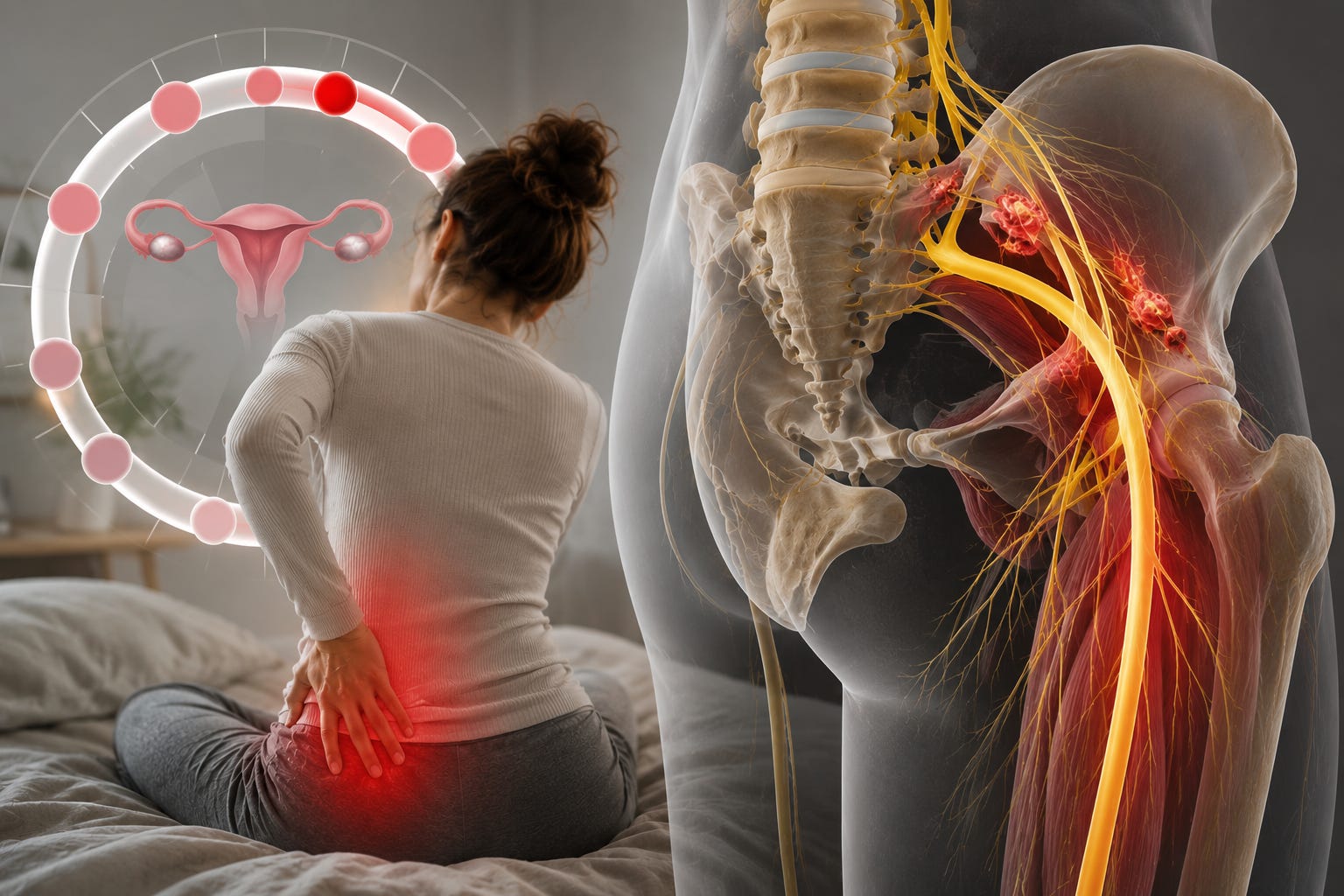
Your sciatic nerve should not need a period tracker.
That sentence sounds almost absurd, but it captures one of the most important patterns that gets missed in complex pain.
Sciatica is usually treated like a spine problem. Disc irritation. Foraminal narrowing. Piriformis compression. Deep gluteal syndrome. SI joint referral. Hip mechanics. Weak glutes. Tight hip flexors. Poor core stability.
Those things can matter.
But when sciatic pain repeatedly flares right before or during the menstrual cycle, we need to stop and ask a better question.
Not just, “Where is the pain coming from?”
But, “Why does this nerve become more symptomatic during this phase of the cycle?”
That is the pattern most people have never been taught to recognize.
Catamenial means related to menstruation. Catamenial sciatica is sciatic-type pain that has a menstrual rhythm. A woman may describe deep buttock pain that shoots down the back of the thigh, into the calf, foot, or toes. It may feel electric, burning, sharp, heavy, tight, numb, or weak. It may appear around the same time every month. Early on, it may settle between cycles. Over time, the pain-free window may shrink until the symptoms feel more constant, with cyclical spikes.
The key is not only the location.
The key is the timing.
One of the most overlooked drivers is endometriosis affecting, irritating, compressing, or involving the sciatic nerve, sacral nerve roots, lumbosacral plexus, or nearby pelvic nerves. Endometriosis is not just a “bad period” condition. It is an inflammatory condition where endometrium-like tissue grows outside the uterus, creating pain, adhesions, fibrosis, and symptoms that may involve the bowel, bladder, pelvis, fertility, sexual function, and nervous system.
This is why the pattern gets missed.
The sciatica is often louder than the pelvic symptoms.
A patient may have painful periods, bowel discomfort, pain with sex, urinary symptoms, fatigue, heavy bleeding, or fertility concerns, but those symptoms may have been normalized for years. The leg pain becomes the reason she seeks care. So she enters the musculoskeletal system. She gets exercises, adjustments, massage, nerve glides, injections, mobility plans, maybe a lumbar MRI.
Some of it helps.
Then the next cycle comes, and the whole pattern returns.
That return is not noise. It is data.
When the trigger is cyclical, but the treatment plan is purely mechanical, the care plan may keep chasing the output instead of identifying the generator.
This does not mean every cycle-linked sciatica pattern is endometriosis. It means the menstrual link deserves clinical attention. Period-related pain that affects daily life, deep pain with intercourse, cyclical bowel or urinary symptoms, chronic pelvic pain, fertility struggles, and neurological symptoms around the cycle should not be dismissed as unrelated.
A normal lumbar MRI does not evaluate the sciatic notch, sacral roots, or lumbosacral plexus in the way this pattern may require.
A normal pelvic ultrasound does not rule out deep, lateral compartment, or nerve-related endometriosis.
In pelvic nerve endometriosis, the hallmark pattern can include cyclical sciatica associated with menstruation, posterior thigh pain radiating toward the foot, weakness, foot drop, sensory loss, reflex changes, and progressively shorter pain-free intervals.
So here is the pattern I want women and clinicians to notice:
Sciatica that flares before or during the period.
Mostly one-sided buttock-to-leg pain.
Pain that travels down the back of the thigh.
Tingling, numbness, weakness, foot slap, or foot drop.
Pelvic symptoms that seem mild compared with the leg pain.
Pain-free windows that are getting shorter.
Temporary relief from mechanical care, followed by the same monthly relapse.
Red flags need urgent medical attention. New or progressive leg weakness, foot drop, loss of bowel or bladder control, urinary retention, saddle numbness, rapidly worsening neurological symptoms, fever, trauma, or severe bilateral symptoms should not wait.
The most important clinical move is learning how to separate a mechanical sciatica pattern from a cyclical pelvic nerve pattern, because the wrong sequence can waste years.
If this helps one person recognize the cycle link before years of chasing the wrong structure, it is worth passing along.
In the members-only section, I’m going to map the full systems picture behind catamenial sciatica, walk through the anatomy, biomechanics, and physiology, break down symptom clusters and exam findings that matter, show sequencing logic, including what I rule in first, what I rule out early, and where clinicians get misled, and include a short case vignette showing the pivot point where the plan changes.
Paid members get every weekly Root Cause Breakdown, the full archive, and a voice in what we cover next.
